Saudi Arabia’s Megaproject Reality Check: What Riyadh Is Scaling Back and Why
Saudi Arabia is reassessing its grandest megaprojects: which ones are being scaled down, delayed, or paused—and what it says about Vision 2030’s new direction.
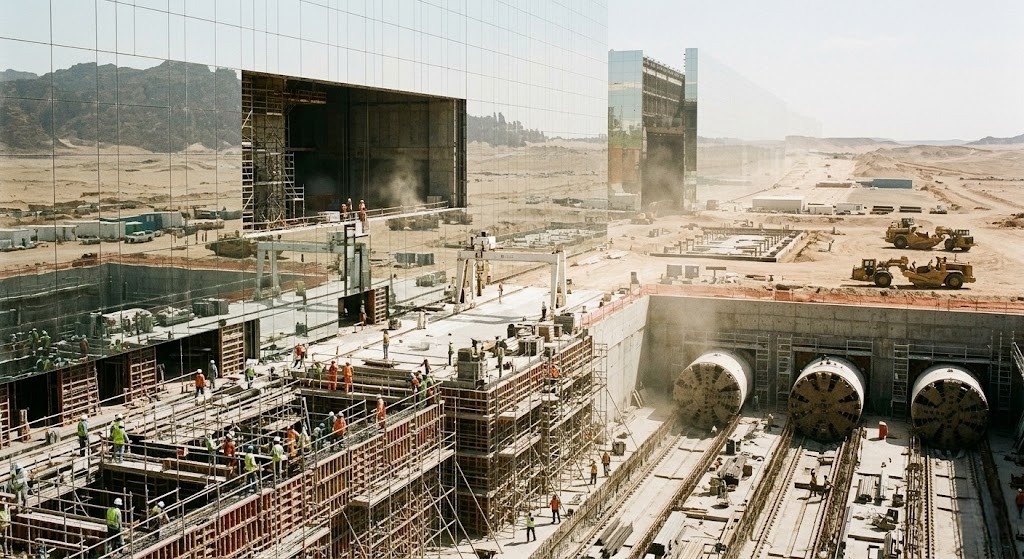
Once a poster child for boundless ambition, Riyadh’s megaprojects are now entering a phase of pragmatism. Renderings of razor-thin linear cities, floating industries, and sprawling resorts are giving way to headlines of postponements, budget cuts, and suspended work. Behind Saudi Arabia’s Vision 2030 dreams lies a harsher financial reality—one that’s forcing adjustments, muffling optimism, and offering lessons on the limits of scale.
What’s Being Paused or Pulled Back
One of the biggest recalibrations involves The Line, NEOM’s signature linear city. Originally stretching 170 kilometers with a target population of 1.5 million, it’s now focused on a tiny 2.4-kilometer “proof of concept” section aiming for 300,000 residents by 2030. Voices inside the project admit the full length is no longer achievable on the original timetable. Parallel to that, some NEOM initiatives—like the mountain-skiing resort Trojena—have been delayed, and the 2029 Asian Winter Games originally slated for Trojena have been postponed indefinitely. Meanwhile, the vast Red Sea development—once expected to host 81 luxury resorts—is now drawing the line at 27, with construction for Phase Two being frozen pending results from the first phase.
In Riyadh itself, the mysterious Mukaab—an immense cube skyscraper planned as a showpiece of the New Murabba downtown project—has had its construction suspended. Though official planning continues, work beyond soil and foundational piles has stopped as Saudi authorities reassess cost, feasibility, and return on investment.
Why These Scale-Backs Are Happening
At the heart of the shift is a squeeze on funding and mounting economic concerns. Saudi Arabia’s sovereign wealth vehicle, the Public Investment Fund (PIF), wrote down the value of its giga-projects by about $8 billion in 2024, citing budget overruns, falling oil prices, and underperforming operational plans. Giga-project investments dropped to 211 billion riyals, down from higher levels, even as total assets under the fund swelled to nearly $913 billion.
Financial pressures also stem from global oil markets, where slipping prices have reduced state revenues and put strain on projections. Demand for ultra-luxury resorts and first-world amenities in desert locales has been softer than hoped. Some resorts are reported to be “mostly sitting empty,” suggesting pricing and value mismatches. Meanwhile, many construction contracts have been either delayed, cancelled, or sharply reduced—some budgets in key projects were cut by as much as 60 percent.
What’s Still Moving Forward—and How Projects Are Being Reprised
Despite retrenchment, several initiatives are still advancing. Infrastructure upgrades in Riyadh are among them. The city now has over 7,200 projects under coordinated implementation, spanning smart grid installations, transportation networks, and utility upgrades. Service networks have expanded past 800,000 km, and over 11.4 million smart meters have been installed or renewed. Permits and licenses for infrastructure projects have surged from 71,000 in 2017 to 151,000 in 2024, with targets of 200,000 by year-end.
Likewise, sectors like artificial intelligence, data centers, and advanced industry are seeing increasing focus. The kingdom is leaning into technology rather than purely physical architecture. New ventures like data center build-outs at NEOM’s Oxagon, PIF-backed AI compute facilities, and mining and minerals production—especially in copper and nickel—are being prioritized. These are viewed as more likely to generate high-growth returns and support diversification away from oil dependency.
The Implications for Vision 2030
Saudi Arabia’s plan to become a global economic and cultural leader by 2030 is undergoing a stress test. Scaling back some of the flashiest megaprojects doesn’t mean abandoning them altogether—but it does underscore a shift in strategy from symbolism to sustainability. Far from failing, many analysts see this as a maturation of Vision 2030: choosing fewer “white elephants,” concentrating on what works, and holding back when projections are unrealistic.
The trade-offs are real. Some jobs will be delayed, contractors displaced, and timelines pushed out. Projects once billed as attractions for international prestige are being viewed with a new lens—do they contribute to non-oil GDP, do they fulfill domestic housing or tourism demand, can they be run sustainably? That shift is already altering what gets funded, how fast, and under whose leadership.
In truth, the megaprojects that survive this reality check may end up with more credibility—and less spectacle—than the ones that aimed too high, too soon.
Conclusion: Saudi Arabia’s megaproject ambition hasn’t crumbled—it’s learning to walk before it flies. Vision 2030’s biggest dreams are being trimmed, delayed, or paused, not because the vision has failed, but because the kingdom is finally adjusting its aims to match its means. What emerges may be less grandiose than what was promised, but vastly more likely to deliver.


