Gut health and fiber: easy daily plan to hit 25–30 grams
Gut Health & Fiber: a practical guide you will actually use ClubRive …
Gut Health & Fiber: a practical guide you will actually use
TL;DR:
- Aim for 25–30 g fiber daily for adults.
- Mix soluble, insoluble, and fermentable fibers.
- Build plates with fruits, veg, whole grains, legumes, nuts, seeds.
- Increase fiber slowly and drink more water.
- Use the 30 g sample day to get started now.
Fiber feeds your gut, supports regularity, and shapes a healthier microbiome. It is not one thing. Different fibers act in different ways, so variety matters.
How much fiber you need
The World Health Organization advises adults to get at least 25 g of naturally occurring dietary fiber each day, alongside 400 g of fruits and vegetables. That guidance was updated on 17 July 2023. The goal is simple, the benefits are broad.
Harvard Health notes a useful rule of thumb. Try about 14 g fiber per 1,000 calories. For many adults, that lands between 25 and 34 g per day. Most people do not reach that amount.
A 2022 BMJ review adds context. It finds that 25–29 g per day lowers risk for heart disease, type 2 diabetes, and all-cause mortality. Getting 30 g or more may help even more.
Types of fiber and why they help
Think of fiber by what it does in your gut.
- Soluble, viscous fibers form a gel. They slow digestion, help with fullness, and can lower LDL cholesterol. Oats and barley are classic sources.
- Insoluble fibers add bulk and speed transit. They support regularity. Whole wheat bran and many vegetable skins fit here.
- Fermentable fibers and prebiotics feed gut microbes. Microbes convert them into short-chain fatty acids like butyrate, which support the gut lining and immune function. Inulin, fructo-oligosaccharides, and resistant starch are examples.
Most plant foods contain a mix. Eating across categories covers your bases.
What fiber does for your gut and beyond
- Regularity. Fiber increases stool bulk and softens stool, reducing constipation.
- Cholesterol and blood sugar. Viscous fibers like oat ?-glucan lower LDL and improve glycemic control.
- Microbiome health. Fermentable fibers increase short-chain fatty acids that help maintain the intestinal barrier and reduce inflammation.
- Long-term risk. Higher fiber intake links with lower risk of cardiovascular disease, stroke, diabetes, and mortality.
How to hit 25–30 g without counting all day
Use this simple pattern at most meals:
- Fill half your plate with vegetables or fruit.
- Make grains whole. Choose oats, brown rice, barley, whole-wheat pasta, or a high-fiber cereal.
- Add a legume most days. Beans, lentils, chickpeas, or peas.
- Sprinkle nuts or seeds for a fiber boost.
A one-day 30 g fiber plan (swap to taste)
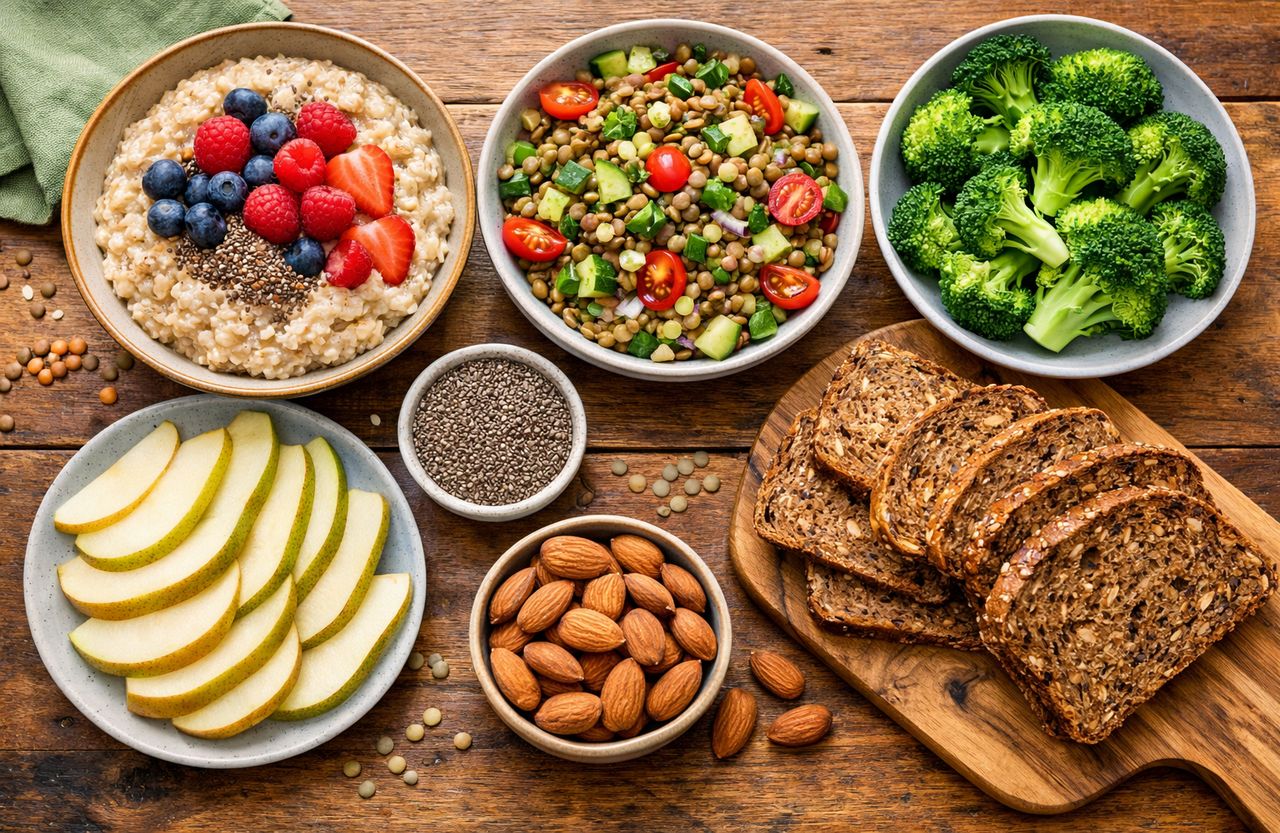
| Meal | Food | Approx. fiber (g) |
| Breakfast | 1 cup cooked steel-cut oats | 4.0 |
| 1 tbsp chia seeds | 4.1 | |
| 1 medium pear | 5.5 | |
| Lunch | 1/2 cup cooked lentils, in salad or soup | 7.8 |
| 1 cup cooked broccoli | 5.2 | |
| Snack | 1 oz almonds | 3.5 |
| Daily total | 30.1 |
Values use Harvard’s food tables and standard portions. Your exact totals may vary slightly.
Fast swaps that keep fiber high
- Oats ? barley or quinoa at breakfast.
- Pear ? apple or berries.
- Lentils ? black beans or chickpeas.
- Broccoli ? Brussels sprouts or kale.
- Almonds ? pistachios, pumpkin seeds, or ground flax.
Building a fiber-smart grocery list
- Vegetables and fruit. Broccoli, Brussels sprouts, carrots, sweet potato, leafy greens, berries, pears, apples, avocado.
- Grains. Oats, barley, brown rice, bulgur, whole-wheat pasta, high-fiber cereal.
- Legumes. Lentils, black beans, chickpeas, split peas, edamame.
- Nuts and seeds. Almonds, pistachios, chia, flax, pumpkin seeds.
Harvard’s 2024 list shows how quickly beans, berries, and seeds add up. Use it to mix and match.
Prebiotics, resistant starch, and your microbiome
Prebiotic fibers are fermentable fibers that, when consumed, produce a health benefit through the microbiota. Inulin and fructo-oligosaccharides are common examples in foods like onions, garlic, leeks, and chicory. Resistant starch appears in cooked-and-cooled potatoes or rice, under-ripe bananas, and some pulses. These fibers help microbes make butyrate and other short-chain fatty acids that support gut barrier integrity.
You do not need to buy supplements to get prebiotics. A varied, plant-forward plate covers most needs. If you do consider a fiber supplement, know that only a few have strong clinical evidence for specific outcomes, and foods still provide more nutrients per bite.
How to increase fiber without discomfort
Jumping from 10 g to 30 g in a day can cause gas or bloating. Follow this checklist.
Fiber ramp-up checklist
- Add 5 g per day, not all at once.
- Drink more water, as fiber holds water in the gut.
- Chew well and slow down.
- Spread fiber across meals and snacks.
- If you have IBS or another GI condition, adjust with your clinician.
Harvard advises gradual increases and more fluids as you scale up.
Common mistakes to avoid
- Relying on refined grains. Swap white rice and regular pasta for whole-grain versions.
- Forgetting legumes. Even 1/2 cup adds 4–8 g. Plan them into soups, curries, and salads.
- Ignoring portion sizes. A handful of nuts or a spoon of seeds can close the gap.
- Expecting supplements to replace food. Food delivers fiber plus vitamins, minerals, and polyphenols.
Why it matters
On 2026-01-07, most adults still miss daily fiber goals. That shortfall means missed protection against constipation, high LDL, glucose spikes, and long-term disease risk. The fix is simple and low cost. Build your plate with plants, most meals, most days.
Sources:
- World Health Organization, “WHO updates guidelines on fats and carbohydrates,” https://www.who.int/news/item/17-07-2023-who-updates-guidelines-on-fats-and-carbohydrates, 17 July 2023.
- Harvard Health Publishing, “The facts on fiber,” https://www.health.harvard.edu/nutrition/the-facts-on-fiber, 1 November 2024.
- Harvard Health Publishing, “Foods high in fiber: Boost your health with fiber-rich foods,” https://www.health.harvard.edu/nutrition/foods-high-in-fiber-boost-your-health-with-fiber-rich-foods, 4 March 2024.
- McKeown NM, Fahey GC Jr, Slavin J, van der Kamp JW. “Fibre intake for optimal health: how can healthcare professionals support people to reach dietary recommendations?” BMJ. 20 July 2022. https://pmc.ncbi.nlm.nih.gov/articles/PMC9298262/


