Why Andrew Tate Is Missing From Theroux’s "Inside the Manosphere" — What It Reveals About Influence Deals
Tate was approached but didn’t appear in Theroux’s film due to fee demands and relevance claims. What does that tell us about influence and power?
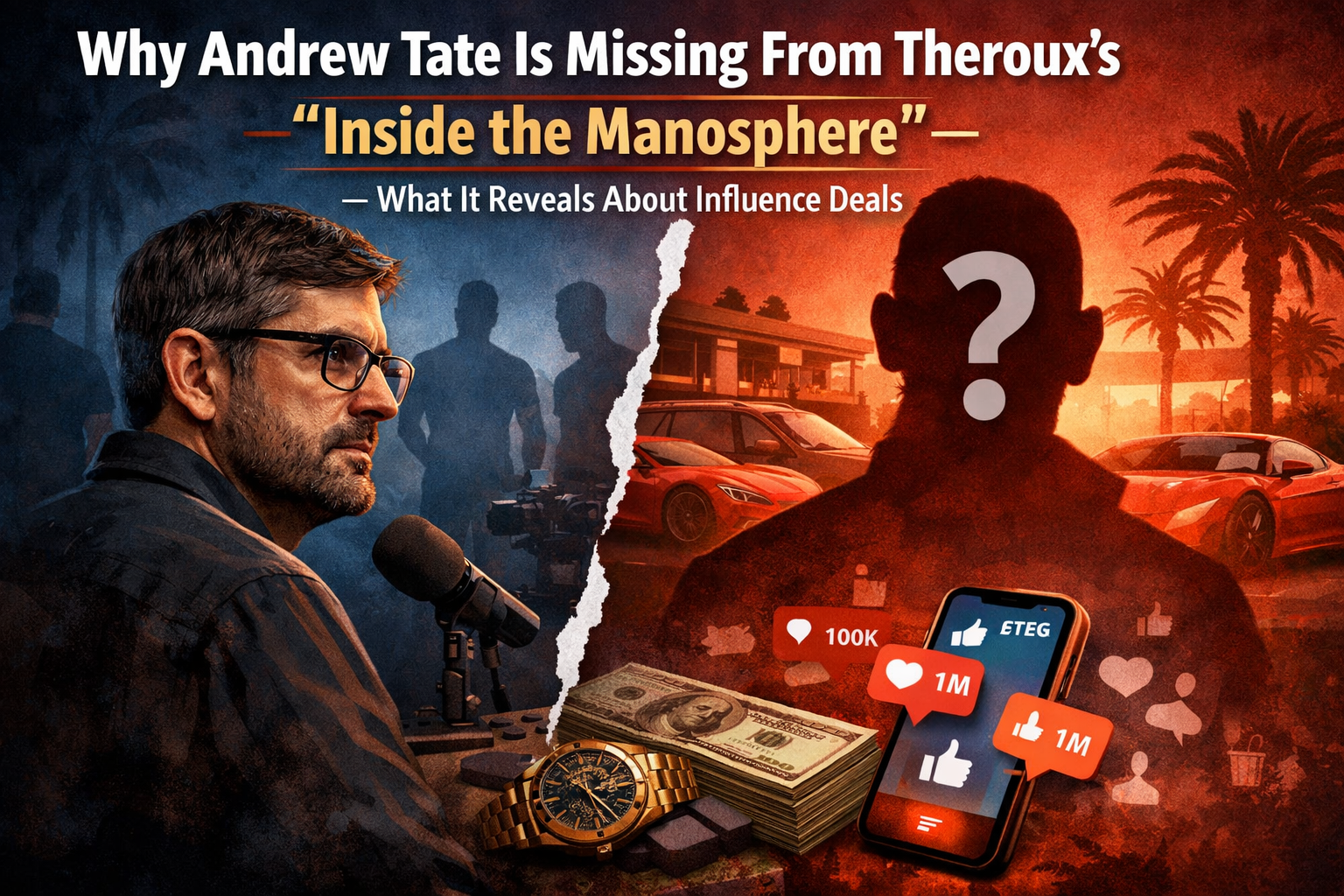
There’s something almost poetic in seeing the man most associated with the online “manosphere” not appear in the documentary that seeks to define and critique it. Though Louis Theroux spends 90 tense, uncomfortable minutes plunging into the world of hyper-masculinity influencers in Inside the Manosphere, Andrew Tate is surprisingly absent on camera. But according to recent interviews, it wasn’t for lack of offers—or of effort.
The “Long Back and Forth” With Tate
Theroux has now revealed his team spent months in negotiation with Andrew Tate and his brother Tristan. The Tate camp was interested—but only “if you pay me,” according to Theroux. The documentarian drew a line: no payment. Tate reportedly countered by claiming Theroux had lost relevance. In a bizarre twist, he sent Theroux a Google Trends graph showing searches for both men over the past several years: his own line skyrocketing in contrast with Theroux’s mostly flat trajectory, with only a rare crossing in the data. Theroux took it in stride, joking that he’d “felt pretty gangster.”
No Google Pay Day, No On-Camera Access
It’s unusual enough when a subject of a documentary refuses to sit for interviews. But usually it’s ideological resistance, not financial demands. Theroux’s refusal to pay Tate marks a rare moment in documentary ethics: insisting that money shouldn’t buy participation. The deal-breaker, it seems, was Tate’s fee. Tate later claimed Theroux “begged me for months but couldn’t afford my fee.”
The Impact of Tate’s Absence
Yet absence doesn’t mean omission. Tate’s presence looms over the film like a spectre. Theroux refers to Tate often, calling him “Exhibit A” of the manosphere—an archetype whose ideas echo through the show. Still, in real terms, the faces in the film are undiluted by the persona everyone has heard of: creators like Harrison Sullivan (HS Tikky Tokky), Sneako, Myron Gaines, Justin Waller, and Ed Matthews lead the charge. One review noted that Theroux “tails” these voices—each charged with red-pill rhetoric, misogyny, and spectacle.
What Influence Deals Really Mean
Tate’s absence tells us something deeper about power, economics, and visibility in online culture. Influence isn’t just about what you say; it’s about who you are, what you can charge, and whether you’re willing to play the game. When someone like Tate demands payment to appear, it forces filmmakers and platforms to confront what they’re willing to “purchase” on the influence marketplace. Is the most notorious figure in the space too valuable to discount—or too controversial to afford?
Another layer: the trade-offs of inclusion. Had Theroux paid Tate’s fee, would audiences accept the presence of funds changing access? Would it signal complicity with the same systems being critiqued?
Statistics and Stakes
- At its cultural height in 2022–23, Andrew Tate had 9.9 million followers on X, making him one of the most visible faces of the manosphere worldwide.
- Theroux’s documentary dropped on Netflix on 11 March 2026.
- The legal weight behind Tate is massive: he and his brother face multiple civil and criminal allegations in the U.K., U.S., and Romania—for rape, human trafficking, and forming organised crime.
- Meanwhile, audience metrics show that podcasts and livestreams hosted by Tate or aligned thinkers amass tens of millions of views, remaining major nodes in this space even without formally participating in Theroux’s film.
What This Says About Visibility and Credibility
Theroux’s choice to not pay—but to reference Tate—suggests that visibility isn’t just a matter of being seen or heard. It’s about who offers participation at what price, who holds power over representation, and whose narratives get mediated through profit or gatekeeping. Tate’s playground thrives on controversy and spectacle, but also on leverage. The power to demand participation reflects how influence can give someone agency even in absence.
Relevance, Reputation, and the Flicker of Redemption
Tate claiming Theroux was “not relevant anymore” is part performance, part barometer of what “relevance” even means in the manosphere. One moment dominating search trends does not map neatly onto changing influence—but it’s a reminder that visibility and clout dance constantly together, even as they slip away.
For Theroux, it’s not just showing the shadow cast by known figures; it’s parsing the emergent voices who pick up that shadow. The likes of HS Tikky Tokky and Sneako don’t just mimic; they innovate the spectacle.
What Theo Audience Uptake Suggests
Early reactions to Inside the Manosphere have been mixed. Some praise its clarity in showing how content creators monetize controversy. Others critique it for insufficient counterbalance—particularly when it comes to women’s voices and concrete harm. But one thing is clear: asking the moral and economic cost of giving someone like Tate a platform—even indirectly—is now part of the conversation.
Theroux didn’t need Tate in front of the camera to show Tate: in the rhetoric, the imitators, the economic models, the view counts. The demand for inclusion, access, and profit is in every red-pill lecture and every angry podcast monologue.
Conclusion: In refusing Tate’s price, Theroux draws a line—not just in budget, but in ethics. Tate’s absence is both a statement and a symptom—of influence that can’t always be bought, of relevance that’s constantly contested, and of a culture wrestling with how much visibility is worth.